The complete guide
Choosing Children's Telescope in Ireland
It gives wide and close-up views of the Moon, showing craters and other surface detail.
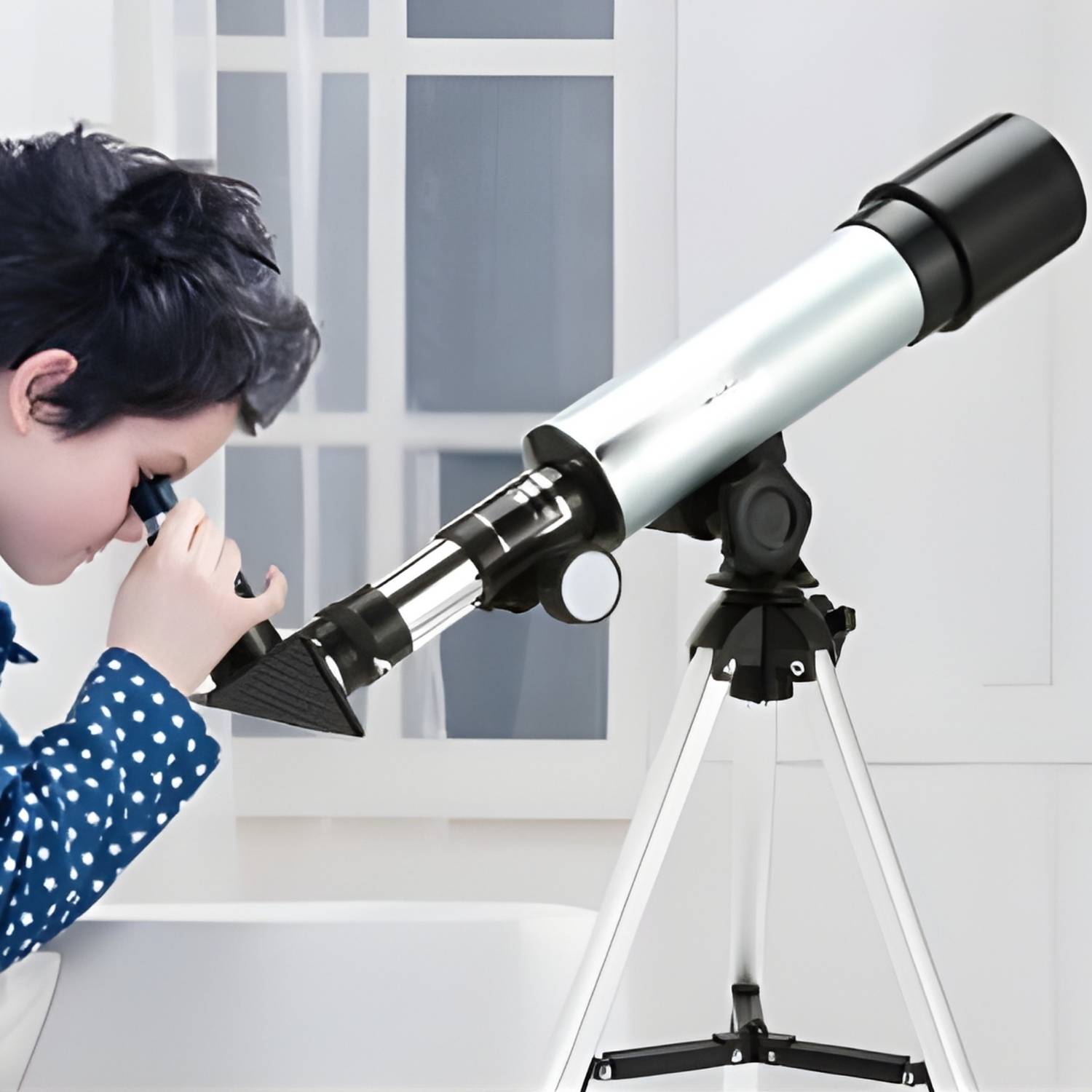
It is a compact telescope made for beginners.
SPECIFICATIONS
- 18x and 90x magnification eyepieces
- 360mm focal length
- 50mm objective lens diameter
- 3.2cm optical system
Delivery takes 5 to 7 days
Direct To Your Door - All Across Ireland
Multiple Magnification Options for Versatile Viewing
The listing gives four magnifications, 18x, 27x, 60x and 90x, from combining the included eyepieces with the 1.5x Barlow lens. Find a target at low power, then switch up to look closer.
Optics
This refractor has a 50mm aperture with a 360mm focal length, a maximum magnification of 90x and a listed theoretical resolution of 2000 arcseconds. The listing describes the lenses as fully multi-coated optical glass, which cuts reflections so more light reaches the eye.
Quick Setup Without Tools
The listing says assembly takes less than one minute using the included instruction manual, with no tools required. The telescope adjusts 160 degrees vertically and rotates 360 degrees horizontally.
Portable Aluminum Tripod System
The adjustable aluminium tripod sets the telescope at different heights and angles. Both telescope and tripod pack into the included carrying bag for trips to darker skies. Parents and children can use it together.
Frequently Asked Questions
Kids Telescope: A Guide for Parents and Young Astronomers
Has your child ever spotted the moon in the evening sky and asked about the stars, the planets and what lies beyond? A kids telescope gives those questions somewhere to go: they can look for themselves.
The question for most parents is how to get a clear view from a telescope that a child can set up and use. Blurry images and a hard setup are the usual reasons a first night goes badly.
This guide covers choosing and using a space telescope for kids: which specifications matter, how to set up and focus, and what you can expect to see from your backyard.
Understanding Kids Telescopes: More Than Just Toys
First, here is how a kids telescope differs from a toy and from professional equipment.
What to Look for in a Space Telescope for Kids
An astronomical telescope for children sits between a toy and professional equipment. It should show real detail and still be simple for a beginner to use.
With a beginner telescope you can see lunar craters and, on a good night, Saturn's rings and Jupiter's largest moons. The images will not match an observatory, but they are real views of real objects.
A beginner telescope should also suit a beginner: a simple setup, controls that are easy to learn and a size a child can carry outside.
The Science Behind Seeing Stars
Understanding basic telescope operation helps you appreciate what your kids telescope can and cannot show. Telescopes perform two primary functions: they collect light and they magnify images.
Light collection depends on aperture, the diameter of the main lens or mirror. Larger apertures gather more light, revealing fainter objects and showing more detail on bright ones. A 50mm aperture telescope gathers significantly more light than the human eye's 7mm pupil, making objects appear much brighter and clearer.
Magnification makes objects appear larger but does not always show more detail. Magnifying past what the aperture supports gives a larger but fuzzier image, so a high magnification number alone does not mean a clearer view.
Refractor telescopes, the type most common for beginners, use lenses to collect and focus light. They suit the Moon, the planets and bright star clusters, and they need little maintenance.
Essential Specifications That Actually Matter
Telescope specifications can overwhelm parents unfamiliar with astronomy. Let's translate the numbers into practical capabilities you can understand.
Aperture: The Most Important Number
Aperture, measured in millimeters, indicates the diameter of the telescope's main lens. For kids telescopes, apertures typically range from 40mm to 70mm. This specification matters more than any other because it determines how much light the telescope collects.
A 50mm aperture is enough for the Moon, the bright planets and bright star clusters. On a good night you can see lunar craters, Jupiter's cloud bands and Saturn's rings. Smaller apertures around 40mm show the Moon and bright planets, while larger 60 to 70mm apertures show fainter objects and more planetary detail.
Don't be seduced by magnification claims without considering aperture. A telescope advertising 200x magnification with only a 40mm aperture delivers blurry, dim images at high powers. Aperture sets the fundamental limit on useful magnification, roughly twice the aperture in millimeters. A 50mm telescope performs well up to about 100x magnification.
Focal Length and Magnification
Focal length, also measured in millimeters, indicates the distance light travels inside the telescope before coming to focus. For astronomical telescopes for children, focal lengths typically range from 300mm to 600mm. Longer focal lengths produce higher magnifications with the same eyepiece.
Magnification results from dividing focal length by eyepiece focal length. A 360mm focal length telescope with an 18mm eyepiece produces 20x magnification (360 ÷ 18 = 20). The same telescope with a 6mm eyepiece delivers 60x magnification (360 ÷ 6 = 60).
This kids telescope includes two eyepieces and a Barlow lens for different magnifications. Lower powers give wider views for scanning the Moon's full disk or finding objects in the sky. Higher powers show finer detail on planets or single lunar features.
Optics and Coatings
Lens coatings affect the image as well as aperture and focal length. Fully coated optics have anti-reflection coatings on the glass surfaces. The listing describes this telescope's optics as fully multi-coated.
These coatings reduce the light lost to reflection, which gives a brighter view with more contrast.
The difference is easiest to see on the Moon's craters and edges.
Features That Enhance the Stargazing Experience
A few other features make a telescope easier for a young astronomer to use.
Tripod Stability and Adjustability
The tripod supporting your astronomical telescope for children matters as much as the telescope itself. Shaky, wobbly tripods make focusing impossible and turn every attempt to center objects into frustrating struggles.
This telescope's tripod is aluminium rather than thin plastic. It adjusts for height, so a child can use it standing or seated, and packs into the carrying bag.
The mount connecting telescope to tripod should allow smooth motion both vertically and horizontally. A stiff mount makes it hard to follow an object, while a loose one lets the telescope drift when you let go. A good mount moves easily when adjusted and holds still when released.
Eyepiece Selection and Barlow Lenses
Multiple eyepieces transform a single kids telescope into a versatile observing instrument. A typical beginner set includes two or three eyepieces providing low, medium, and high magnification options.
Low power eyepieces (typically 18-20mm focal length) deliver wide views perfect for scanning the Moon, locating planets, or observing large star clusters. These lower magnifications show brighter images and wider fields, making objects easier to find and keep centered.
High power eyepieces (typically 4-6mm focal length) magnify small details on planets or specific lunar features. While showing smaller areas of sky, these eyepieces reveal finer details when atmospheric conditions cooperate.
Barlow lenses multiply magnification by inserting between eyepiece and telescope. A 1.5x Barlow converts an 18mm eyepiece into effective 12mm magnification (18 ÷ 1.5 = 12), while a 3x Barlow creates 6mm equivalent magnification. This multiplies your eyepiece collection's versatility without buying additional eyepieces.
Finderscopes and Alignment Tools
Finding celestial objects through a telescope's narrow field of view challenges even experienced astronomers. Finderscopes, small low-power telescopes mounted atop the main telescope, make locating objects dramatically easier.
These finders show much wider sky areas than the main telescope, making it simple to point at your target. Once centered in the finder, objects appear in the main telescope's field. Without a finder, you're essentially pointing a narrow tube at the sky hoping to randomly encounter your target.
Some space telescopes for kids use red dot finders instead of traditional finderscopes. These project a red dot onto a clear window, allowing you to point at objects with both eyes open. While less precise than optical finders, red dot finders work well for the Moon, bright planets, and large star clusters.
What You Can Actually Observe With Kids Telescopes
Understanding realistic expectations prevents disappointment and helps you maximize successful observations with your astronomical telescope for children.
The Moon: Your First and Best Target
The Moon is the easiest first target for a kids telescope. It is large, bright and easy to find, and even a small telescope shows craters, mountain ranges, valleys and maria (dark plains).
The best lunar observing occurs along the terminator, the line separating day and night on the Moon's surface. Here, low sun angles create dramatic shadows highlighting three-dimensional terrain features. Full moon appears bright and impressive but shows less detail because overhead sunlight eliminates shadows.
Different magnifications reveal different lunar aspects. Low powers show the entire disk, perfect for appreciating the Moon's overall appearance and major features. High powers zoom into specific craters or mountain ranges, revealing intricate details of individual formations.
Planets: The Solar System in Your Backyard
An astronomical telescope for children can show some planetary detail. Saturn's rings are one of astronomy's most rewarding sights, and Jupiter shows cloud bands across its disk plus four bright moons.
Mars reveals its distinctive red color and, during favorable oppositions when it approaches Earth closely, hints of darker surface features. Venus displays phases like a miniature moon, waxing and waning as it orbits between Earth and Sun.
Mercury sometimes appears in evening or morning twilight, while Uranus and Neptune are within reach of a 50mm telescope but show only as tiny coloured dots. Knowing what to expect helps avoid disappointment.
Stars, Clusters, and Beyond
Individual stars don't appear larger through telescopes because their immense distances render them essentially point sources of light. However, telescopes reveal thousands of stars invisible to naked eyes, transforming familiar constellations into dense star fields.
Star clusters provide spectacular views through kids telescopes. The Pleiades star cluster showcases dozens of bright stars nestled together, while double stars reveal their true nature as two stars orbiting each other. Some doubles show contrasting colors, one star appearing orange while its companion shines blue-white.
Galaxies and nebulae are hard targets for a small telescope, though the brightest, like the Orion Nebula or the Andromeda Galaxy, show as faint fuzzy patches.
Setting Up Your Space Telescope for Kids Successfully
Proper setup makes the first sessions go more smoothly. These steps help.
Assembly and Initial Configuration
This telescope assembles without tools. Begin by setting up the tripod, extending the legs to a comfortable height and placing it on level ground. Lock all adjustment knobs firmly to prevent unexpected collapse.
Attach the telescope to the tripod mount, securing all connection points. Install the finderscope or red dot finder according to instructions, ensuring it points in the same direction as the main telescope. Insert the lowest power eyepiece to provide the widest field of view.
During daylight, practice finding and centering distant terrestrial objects like tree tops or building features. This familiarizes you with how the telescope moves and focuses before attempting to locate celestial targets in darkness.
Focusing Techniques for Clear Views
Achieving sharp focus makes the difference between disappointing blurs and stunning detail. Start with your lowest power eyepiece and brightest target (the Moon if available, or a bright star otherwise).
Turn the focus knob slowly while watching the image carefully. The object will transition from very blurry to slightly less blurry to sharp to blurry again as you pass through focus. When you've gone too far, reverse direction and approach focus from the other side.
Perfect focus produces the sharpest, most detailed image possible. Lunar craters show crisp edges, planetary disks appear distinct, and stars focus to tiny points rather than fuzzy blobs. Atmospheric turbulence causes images to shimmer and dance even when perfectly focused, this is normal and unavoidable.
Finder Alignment Procedures
Aligning your finderscope or red dot finder during daylight saves enormous frustration during nighttime observing. Point your kids telescope at a distant, distinct object like a building corner or isolated tree.
Center the object perfectly in your main telescope's eyepiece. Now look through the finder. The same object should be centered in the finder. If it isn't, adjust the finder's alignment screws until the finder and main telescope show identical views.
Once aligned, the finder stays aligned unless the telescope gets knocked. Anything centred in the finder then appears in the main telescope, which makes targets much easier to find.
Maximizing Success During Observing Sessions
A few habits make observing sessions go better.
Choosing Optimal Observing Conditions
Not all nights offer equal observing conditions. Clear, moonless nights far from city lights provide ideal circumstances, but you don't need perfection to enjoy your astronomical telescope for children.
The Moon remains easily visible even from light-polluted urban locations. Bright planets likewise shine through considerable light pollution. On these targets, convenience matters more than pristine darkness, so backyard observing works perfectly well.
For stars, clusters, and other faint objects, darkness matters more. Even traveling just outside town to darker locations dramatically improves what you can see. Allow 20-30 minutes for your eyes to adapt to darkness, during which faint objects progressively become more visible.
Tracking Celestial Objects
Earth's rotation makes celestial objects drift across your telescope's field of view, exiting the frame within minutes at high magnification. This isn't a defect in your space telescope for kids. It's simply the result of observing from a rotating planet.
Manual tracking involves gently nudging the telescope to keep objects centered. With practice, this becomes automatic and unobtrusive. Start with lower magnifications providing wider fields where objects remain visible longer, building tracking skills before attempting high magnifications.
The Moon moves its own diameter in about two minutes. At low power showing the full disk, you might track for 10-15 minutes before needing adjustment. At high power showing a single crater, recentering becomes necessary every minute or two.
Recording Observations and Building Skills
Keeping an observation log, with dates, times, objects and short descriptions, builds a record of everything your child has seen.
Sketching what you see, even simply, makes you look more carefully, and the sketches become a record of what you found.
Photography through a kids telescope is possible but takes practice. This kit does not include a phone adapter, so hold the phone steady at the eyepiece by hand. A recognizable photo of the Moon is a good first goal.
Troubleshooting Common Problems
Every beginner runs into problems sometimes. Here are the common ones and how to fix them.
Blurry or Unfocused Images
If you cannot achieve sharp focus regardless of focus knob position, several factors might be responsible. Most commonly, the eyepiece sits at the wrong height relative to the telescope. Some telescopes include extension tubes or diagonal prisms that must be inserted or removed to achieve focus.
Atmospheric turbulence also affects focus, causing images to shimmer, dance, and appear soft even when the telescope focuses perfectly. This proves especially problematic when observing shortly after sunset when ground heat creates turbulent air. Later observations after the ground cools often show steadier images.
Dirty optics degrade image quality dramatically. Dust on lenses or eyepieces scatters light, reducing contrast and sharpness. Clean optics carefully using appropriate lens cleaning supplies, never household cleaners or rough materials that scratch delicate coatings.
Difficulty Finding Objects
If you struggle to locate celestial targets, first verify your finder remains aligned with the main telescope. Finders get knocked out of alignment easily, making target location nearly impossible.
Start with easy targets before attempting challenging ones. The Moon, when visible, provides the perfect starting point. Once you've successfully found, centered, and focused on the Moon, move to bright planets or easy star clusters. Build skills progressively rather than immediately attempting difficult targets.
Use planetarium apps on smartphones to identify what's currently visible and where to look. These apps show real-time sky maps, pointing you toward planets, constellations, and interesting objects worth observing through your kids telescope.
Shaky or Unstable Images
Vibrations make viewing frustrating and detail impossible to resolve. Wind rocks the telescope, nearby foot traffic transmits vibrations through the ground, and even touching the telescope to adjust it causes shaking.
Ensure tripod legs lock firmly and stand on solid surfaces rather than soft ground where possible. Let vibrations dampen before observing after adjusting the telescope. On very windy nights, consider rescheduling observations for calmer conditions.
Some vibration simply reflects high magnification amplifying every tiny movement. Lower magnifications show steadier images because they amplify motion less. When conditions prevent steady high-power viewing, enjoy excellent low-power views instead of fighting frustration.
Maintaining Your Astronomical Telescope for Children
Careful storage and cleaning help your space telescope for kids keep working well.
Cleaning and Storage
Store your telescope in its case or covered location protected from dust, moisture, and temperature extremes. Basements and garages work well if they stay dry. Avoid attics where summer heat and winter cold create damaging temperature swings.
Clean lenses only when necessary using appropriate lens tissue and cleaning solution designed for optical glass. Never use household glass cleaners, paper towels, or rough materials. Blow away loose dust with compressed air before wiping to avoid grinding particles across delicate surfaces.
Eyepieces deserve particular attention because they're handled frequently and collect dust easily. Keep caps on eyepieces when not in use. Store them in protective cases rather than loose in bags where they can scratch or collect debris.
Transportation and Handling
A kids telescope needs careful handling. Use the carrying bag when taking it to an observing spot, and pad it in a vehicle to avoid knocks.
Teach young users to handle the telescope gently, avoiding impacts and rough treatment. While construction can tolerate normal use, dropping or striking the telescope can knock optical elements out of alignment or crack lenses.
Check all adjustment knobs periodically to ensure they remain snug but not overtight. Verify the finder stays aligned before observing sessions. Test focus mechanisms to confirm smooth operation without excessive force required.
Growing With Your Telescope
As your child gets more confident, there is more to find with the same telescope.
Advancing Skills and Knowledge
As your young astronomer gets to know the telescope, try harder targets. After the Moon and the bright planets, try star clusters, double stars and bright nebulae.
Introduce constellation learning using apps or star charts. Understanding how celestial objects relate to constellation patterns makes navigation and target location progressively easier. This knowledge transforms random star groupings into familiar signposts guiding you across the night sky.
Connect observations to broader scientific understanding. Discuss why Saturn has rings, how craters formed on the Moon, or why planets appear brighter than stars. These connections transform telescope views from pretty sights into windows revealing the universe's underlying principles.
Joining the Astronomy Community
Local astronomy clubs welcome beginners enthusiastically, offering observing sessions, workshops, and mentoring from experienced astronomers. These connections provide guidance, answer questions, and introduce young astronomers to others sharing their passion.
Public star parties put quality telescopes in your child's hands, showing what advanced equipment reveals while connecting with the broader astronomy community. These events demonstrate that astronomy isn't solitary but social, shared with enthusiasts worldwide.
Making Your Decision
After exploring every aspect of kids telescopes, how do you decide if investing in an astronomical telescope for children makes sense for your family?
A telescope suits a child who is interested in space, whether that is passing curiosity or a deep fascination.
Astronomy takes patience, and finding Saturn's rings for the first time is something to be proud of.
Consider your specific situation. If you live under reasonably dark skies with clear weather, telescopes deliver their full potential. Urban locations with light pollution still permit excellent lunar and planetary observation. Only the most light-polluted environments significantly limit what you can observe.
Ordering in Ireland
Standard delivery is €25, or free from €100 after discounts. Express Delivery is €25. Allow 24 to 48 hours for processing and 5 to 7 days for delivery; no separate express arrival date is guaranteed.
For the return conditions and next steps, read the full returns policy. Contact the team before ordering if a specification or compatibility detail is essential.